A tooth, a name and a century of finds
The first T. rex remains are older than the name. A student working under Arthur Lakes found a tooth near Golden, Colorado, in July 1874. In the early 1890s John Bell Hatcher collected bones in eastern Wyoming that were first filed under another dinosaur. Barnum Brown then found a partial skeleton in Wyoming in 1900 and a second, much better one in the Hell Creek Formation of Montana in 1902. In 1905 Henry Fairfield Osborn named Tyrannosaurus rex, “tyrant lizard king”, for the Montana skeleton, and in 1906 he recognised both of Brown’s skeletons as one species. The animal lived in the last years of the Cretaceous, in the late Maastrichtian about 69 to 66 million years ago, on the island continent of Laramidia, now western North America.
Sue, and the fight over a fossil
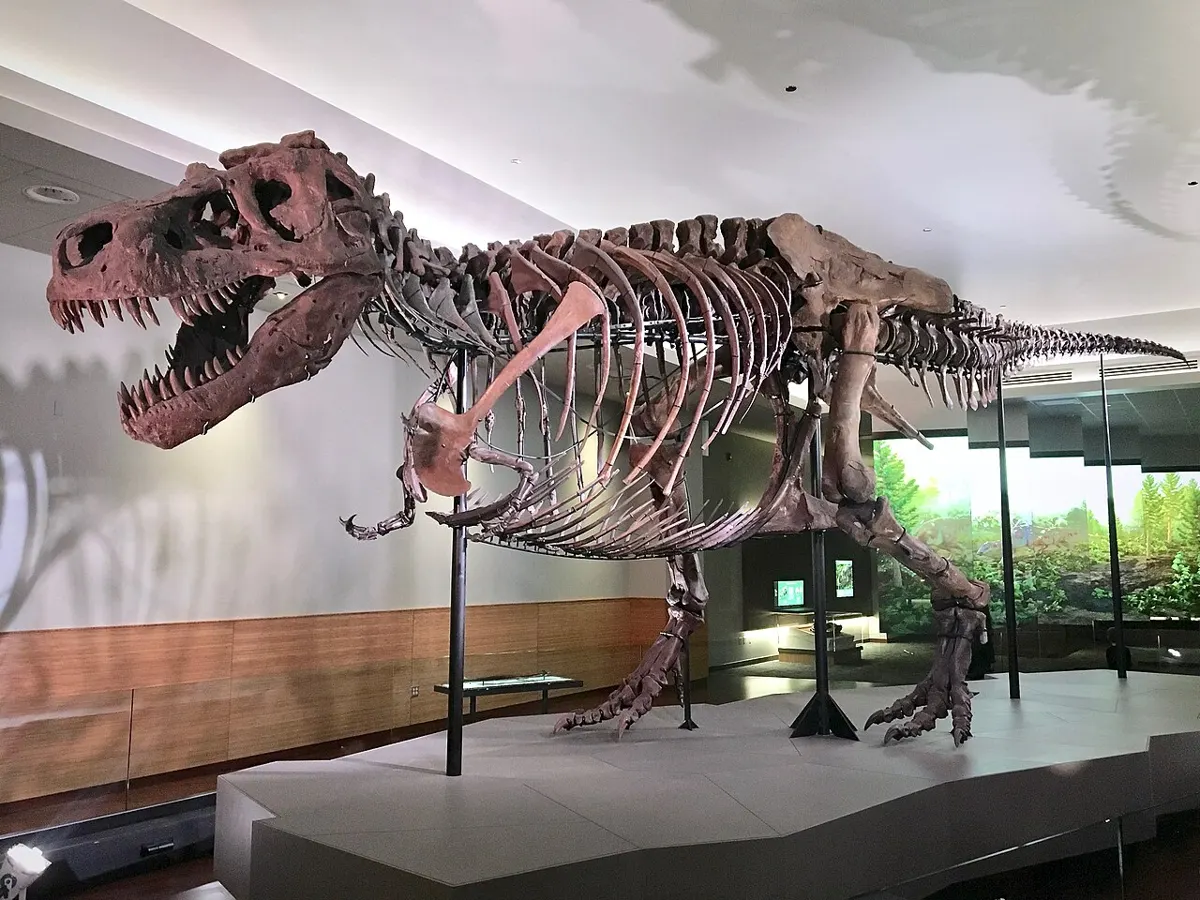
The most famous individual is Sue. Sue Hendrickson found the skeleton on 12 August 1990 near Faith, South Dakota, on the Cheyenne River Indian Reservation. The Black Hills Institute paid the landowner, Maurice Williams, $5,000, but the land was held in trust by the US Department of the Interior, and in 1992 the FBI and the South Dakota National Guard seized the fossil. A civil case decreed that Williams still owned it. At a Sotheby’s auction on 4 October 1997 the Field Museum won it with a bid of $7.6 million, and the final cost was $8,362,500, helped by sponsors that included the Walt Disney Parks and Resorts and McDonald’s. Sue was unveiled on 17 May 2000, and a new gallery opened on 21 December 2018.
The skeleton is about 90% complete by bulk and 73% by elements, around 250 of the 360 bones known for the species. It reads like a medical chart: three broken ribs, a damaged right shoulder blade, a torn arm tendon, an infected left fibula, probable gout, and holes in the skull that a 2009 study linked to a parasitic infection. Sue died at an age estimated between 27 and 33 years.
What science actually knows
Sue measures 12.3 to 12.8 metres and stands 3.66 to 3.96 metres at the hip. Mass is far less certain. Estimates for adults ran from about 4.5 tonnes in the 1980s to more than 7.2 tonnes in 1999, and most modern figures fall between 5.4 and 8 tonnes, although the 2018 estimates for Sue alone ranged up to 14. The Royal Saskatchewan Museum’s Scotty, at about 13 metres and an estimated 8.87 tonnes, is the largest known individual. The largest skull, MOR 008, is 1.52 metres long, and the biggest known tooth was about 30.5 centimetres including its root.
The skull was wide at the back and narrow at the snout, giving good binocular vision. A 2017 study in Scientific Reports by Paul Gignac and Gregory Erickson, modelled on crocodile jaw muscles and checked against a Triceratops pelvis carrying nearly 80 bite marks, put the bite at about 8,000 pounds of force, roughly 35,000 newtons, enough to crush bone. Bone-slice studies show an S-shaped growth curve: a young T. rex stayed below about 1,800 kilograms until roughly 14 years old, then gained about 600 kilograms a year for four years and levelled off around 18. A 2016 study confirmed medullary bone, the tissue female birds make for eggs, in a specimen nicknamed B-rex. The old debate over whether T. rex was a scavenger is now treated as settled in favour of a hunter that also scavenged.
Two arguments still running
The first is Nanotyrannus. For years many palaeontologists, following Thomas Carr in 1999, treated this small tyrannosaur as a juvenile T. rex. In 2025 Zanno and Napoli argued in Nature, from growth rings and bone fusion in the Dueling Dinosaurs fossil, that it was a fully grown animal of about 20 years and a separate genus, and they named a second species, N. lethaeus, for the Jane specimen. Steve Brusatte, who was not an author, called it a fundamental reassessment, and the debate continues.
The second is whether T. rex is really three species. In 2022 a paper led by Gregory Paul proposed T. rex, T. imperator (including Sue) and T. regina. Several specialists, including Steve Brusatte, Thomas Carr and Thomas Holtz, criticised it, and Philip Currie withdrew from the study. Paul still defended the split in 2025. Treat the single name as the working consensus.
The Rex in ARK
The Rex has been in ARK since the early-access launch on Steam in June 2015, and its dossier, credited to the survivor Helena Walker, names it Tyrannosaurus dominum, calling it arguably the deadliest creature on the Island. The wiki lists base health of 1,100 with 220 more per level and a 62-point bite. It generally ignores mounted tames but attacks wild animals, dismounted players and helpless tames. Its roar stuns targets for three seconds and grounds flyers within its limits. It has a passive 15% bonus against herbivores, a saddle that unlocks at level 74 and a Tek saddle variant.
Over the years the Rex gained relatives: the Tek Rex, added permanently with the ARKaeology event; the Corrupted Rex on Extinction, which cannot be tamed; the X-Rex of Genesis: Part 1, which can; and event-only Rex Ghosts. The Rex, Tek Rex and Corrupted Rex all drop a guaranteed Tyrannosaurus Arm, a nod to the real animal’s famously short forelimbs. In Raconin’s video the Rex is the workhorse: a boss-fight tame and, with a Tek saddle, a way to push Tek structures.
What the game gets right, and what it invents
Right: the Rex is the apex predator of its world, a bone-crusher with a bite that makes the rest of the roster think twice, and the arm drop is a cheerful wink at the anatomy.
Invented: the stunning roar, the herbivore bonus and the Tek and Corrupted versions, none of which has any fossil support. The dossier’s “deadliest” label is a game claim, not a science one. And the game does not take a side in the Nanotyrannus or three-species arguments: the Rex it gives you is one animal, which matches the current consensus.
See it in the game
Want to see how it plays? Raconin’s video shows how to tame it in ARK: Survival Ascended. Click to load it here, or watch it on his channel.
Frequently asked questions
Video credit. The gameplay video at the end is made by Raconin and shown with his permission. The article itself is ParryStack's own research from the sources listed below. Updated 1 November 2026.
Questions or a better method? Ask in the ARK community or share a tip.
Sources & fact-check
Facts on this page were checked against these sources on 1 November 2026. Spotted an error? Tell us. See our editorial standards.
- Wikipedia: Tyrannosaurus
- Wikipedia: Sue (dinosaur)
- ARK Wiki: Rex
- Gignac and Erickson (2017), Scientific Reports
- NPR: T. rex bite force measured at 8,000 pounds (2017)
- Stony Brook University: new analysis of the Dueling Dinosaurs fossil (2025)
- University of Alberta: the 2022 three-species proposal and its critics
- Raconin on YouTube: The easiest way to tame a T. rex