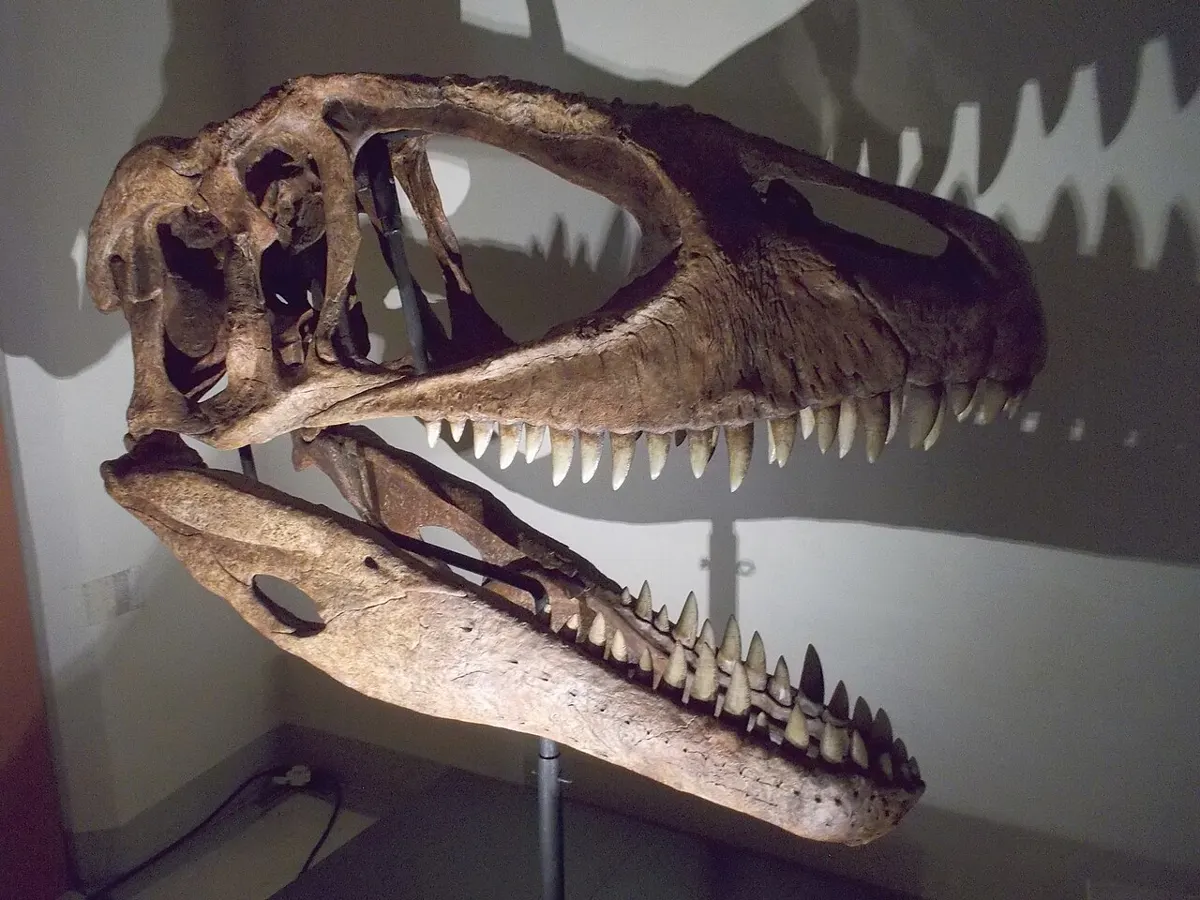
Two teeth and a lost skeleton
Carcharodontosaurus entered science in pieces. In 1924 two teeth were pulled from the cut walls of an irrigation tunnel, a foggara, near Timimoun in French Algeria. Charles Depéret and Justin Savornin described them the following year as a species of Megalosaurus, the first meat-eating dinosaur fossils ever described from that part of the Sahara. Those teeth have since been lost, so the very first evidence for the animal can no longer be examined.
The specimen that gave the genus its name travelled a longer road. Richard Markgraf, collecting for the Munich palaeontologist Ernst Stromer, found a partial skeleton near Ain Gedid in Egypt in 1914. Delays caused by the First World War meant it reached Munich only in 1922. In 1931 Stromer used it to erect the genus: Carcharodontosaurus, “sharp-toothed lizard”, a name that compares the animal’s thin, serrated teeth with those of the great white shark, Carcharodon. Stromer thought it measured about 8 to 9 metres. Then, on the night of 24 to 25 April 1944, a British air raid on Munich destroyed the skeleton. Only a cast of the brain cavity survived.
A replacement skull, and a new name for the original
For half a century the animal was known from drawings, photographs and scraps. In 1995 an expedition led by Paul Sereno found a large, incomplete skull in the Kem Kem Beds of south-eastern Morocco and described it in Science the next year. In 2007 that skull was formally proposed as the neotype, a new reference specimen standing in for the lost one. The same year Steve Brusatte and Sereno named a second species, C. iguidensis, from Niger, although more recent work questions whether that species belongs in the genus at all.
In January 2025 came the twist. Maximilian Kellermann, Elena Cuesta and Oliver Rauhut published a reassessment of Stromer’s destroyed skeleton in PLOS ONE, working from the surviving brain-cavity cast, two archival photographs that had not been catalogued before, and Stromer’s original drawings. Their conclusion: it was a different animal, which they named Tameryraptor. It has a small horn-like bump on the nasals and a smaller upper jaw with fewer teeth. Researchers still disagree about where it sits on the family tree, because another 2025 study placed it as the closest relative of C. saharicus. Either way, the skeleton that defined the genus in 1931 may not belong to it.
How big, and how dangerous?
Science has not settled the size ranking. For the Moroccan neotype, common estimates are 12 to 12.5 metres and roughly five to seven tonnes. A 2007 study scaled it higher, to about 13.3 metres and 15.1 tonnes, a figure that would put it ahead of Tyrannosaurus. Skull-length estimates for the neotype range from 1.4 to 1.6 metres. Giganotosaurus, a relative from South America, has been estimated larger still, at 13.7 to 14.3 metres and 8 to 10 tonnes. The honest summary is that several giant predators overlap in the estimates, and the size contest matters less than how each one lived.
On that question the evidence points to a slicer rather than a crusher. The skull was lightly built, with a triangular snout and thin, serrated teeth that were replaced quickly. A 2022 study estimated bite forces of about 11,300 newtons at the front of the jaws and about 25,400 at the back, lower than the roughly 35,000 newtons reported in 2017 for a T. rex, although different methods make such comparisons rough. A 2006 study found limited binocular vision, similar to a crocodile’s, which fits an ambush hunter. Oxygen-isotope data suggest it was more of a land animal than Spinosaurus, which shared its world: the two lived side by side in the Kem Kem region about 100 to 94 million years ago, a pattern researchers have read as the two dividing the menu between fish and large land prey.
The Carcha in ARK
The game took the shark comparison and built a mechanic out of it. The Carcharodontosaurus was added to ARK: Survival Evolved in patch 352.6 on 6 November 2022, and it is part of Ascended too. The in-game dossier, credited to the survivor Helena Walker, names it Carcharodontosaurus medicupestis and says it grows more dangerous once it tastes blood, the way a great white does.
That is exactly how it plays. A killing blow triggers Killing Frenzy, a ten-second burst of speed with stun immunity, and adds a stack of Bloodrage. Each stack raises melee damage and healing rate by 1.75%, up to 100 stacks and a 175% bonus. Enemies with more base health give more stacks. Its roar turns the rider’s stacks into a movement-speed buff for nearby allies, lasting up to 55 seconds at full stacks. Its bite applies Shredded, which reduces healing received, and it lives on plain raw meat. It is tamed passively, by dragging fresh kills to it. The ARK Wiki records that Ascended patch 53.1 cut the healing per stack by about 20%, which is worth knowing when you read older advice about building stacks.
The Lord of Winter
The Carcha’s most famous opponent has no fossil record at all. The Ice Titan is one of four Titans on the Extinction map, listed at 77.3 metres tall and 162.3 metres long, with 350,000 base health on the wiki. It is summoned from a terminal in the Snow Dome in the north-east of the map, with a tribute that the wiki lists as an Artifact of the Void, 100 Corrupt Hearts, ten Spinosaurus Sails and ten Therizinosaur Claws. It goes by “Lord of Winter” and “King of Ice”. Of the four, it is the most agile and the only one that does not spawn minions, which suits a mobile melee tame. Its listed attacks include a freezing breath, an ice shot for 500 damage and a ground slam for up to 3,875.
In the story, the Titans are made entirely of Element and were never made for the Arks. Diana’s explorer note #19 calls them “Artificial Hyper Faunal Entities”, while The One Who Waits writes in note #16 that they are pieces of Element’s consciousness and symbols of its hunger and hatred. The wiki also records that Mei Yin, in her Mek, killed Titans in huge numbers, that Diana defeated the Forest Titan, and that the two of them together in the Mega Mek forced the King Titan to retreat. Beat the Ice Titan and the guardian hologram greets you with the line “Thus ends the reign of the Lord of Winter.” Extinction reached Ascended on 20 December 2024 on Steam, Xbox and PlayStation, included with the game, and on Epic on 22 October 2025, according to the wiki.
What the game gets right, and what it invents
Right: a hunter built around a serrated, slicing bite rather than bone-crushing, and a predator of big land animals rather than a fish-eater. The isotope evidence for a more land-bound animal than Spinosaurus fits a Carcha that fights on foot. The game also takes no side in the size contest.
Invented: the blood-driven frenzy. The great-white comparison is the dossier’s own, and no fossil says anything about berserker behaviour or ally-buffing roars. The Ice Titan is pure fiction and needs no defence.
See it in the game
Want to see how it plays? Raconin’s video shows how to fight it in ARK: Survival Ascended. Click to load it here, or watch it on his channel.
Frequently asked questions
Video credit. The gameplay video at the end is made by Raconin and shown with his permission. The article itself is ParryStack's own research from the sources listed below. Updated 1 November 2026.
Questions or a better method? Ask in the ARK community or share a tip.
Sources & fact-check
Facts on this page were checked against these sources on 1 November 2026. Spotted an error? Tell us. See our editorial standards.