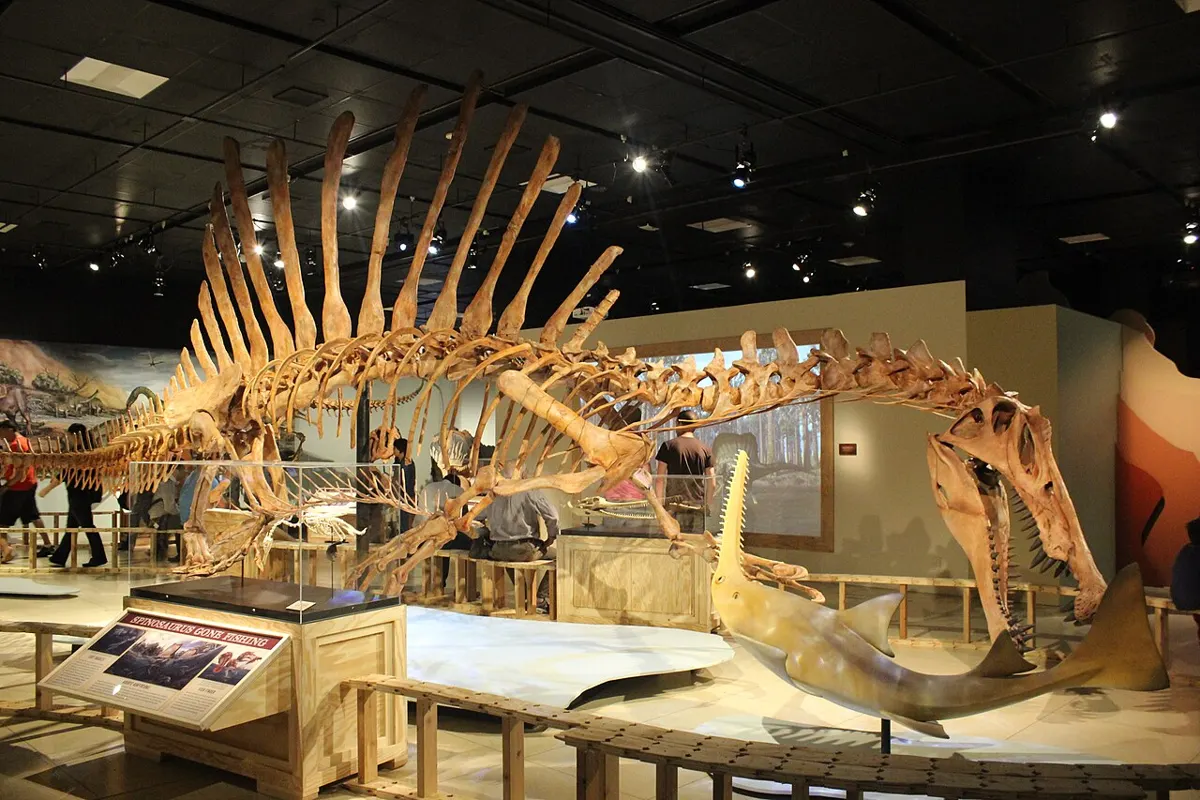
A sail, and a gap in the record
The first confidently identified Spinosaurus bones were found in the autumn of 1912 by Richard Markgraf in the Bahariya Formation of Egypt. In 1915 Ernst Stromer named the animal Spinosaurus aegyptiacus, “Egyptian spine lizard”, after the enormous spines rising from its vertebrae. The holotype was a jumble of jaw pieces, vertebrae, ribs and teeth. A second, poorly preserved skeleton reached Germany in 1922, and Stromer described it in 1934 as “Spinosaurus B”. A 1936 reconstruction filled the gaps with parts borrowed from tyrannosaurs.
Then the evidence vanished. On the night of 24 to 25 April 1944 the Munich collection was bombed and the Spinosaurus material, never moved to safety, was destroyed. For decades the animal existed only as Stromer’s drawings and photographs. His son donated the archive in 1995, and a team studied the photographs in 2006. The same air raid destroyed the Egyptian Carcharodontosaurus skeleton.
The neotype and the swimming dinosaur
The modern story starts in 2008, when a Moroccan fossil collector showed fragments to Nizar Ibrahim. A museum in Milan acquired a partial skeleton in 2009, and in 2013 Ibrahim and colleagues traced the original dealer to the site. In 2014 they described a subadult specimen from the Kem Kem Beds of Morocco, catalogued FSAC-KK 11888, and proposed it as the neotype. They argued for a semi-aquatic animal, noting that the hind limbs were short, just over a quarter of body length. Critics, including a 2015 study led by Serjoscha Evers, rejected the neotype.
The argument escalated. A 2020 paper in Nature described the neotype’s tail: tall neural spines and long chevrons forming a paddle that, tested on robotic models, gave more thrust in water than the tails of land dinosaurs. A 2022 CT-based reconstruction led by Paul Sereno disagreed, picturing a biped on land and a slow surface swimmer with a tail fin mainly for display. Dense bones reported in 2022 were read as evidence of underwater hunting, while a 2024 paper argued the animal hunted more like a heron than a diver. No consensus has emerged in the years since.
Sail, teeth and size
The sail’s job is also open. Proposals include heat control, a fat-storing hump like a bison’s, display and courtship, intimidation, and a fin-like hydrodynamic role. The skull was long, low and narrow like a crocodile’s, with straight, conical, unserrated teeth: six or seven in each side of the front of the upper jaw, and about a dozen further back. The forelimbs were large and stocky, with an enlarged claw on the first finger. It ate fish, but a 2024 paper argued it also took small and medium land animals.
Size estimates have wandered widely. Dal Sasso and colleagues proposed 16 to 18 metres and 7 to 9 tonnes in 2005, Ibrahim’s team argued for more than 15 metres in 2014, and the 2022 CT study gave a maximum of 14 metres and 7.4 tonnes. What is not disputed is the setting: the Cenomanian of the Late Cretaceous, about 100 to 94 million years ago, in humid tidal flats and mangrove forests of what is now Egypt and Morocco.
A second crest, in Niger
In February 2026 the story gained a new character. A 20-person team led by Sereno published a new species, Spinosaurus mirabilis, in Science. It comes from the Farak Formation of Niger, in the central Sahara, and is about 95 million years old. The paper describes it as having the tallest head crest of any theropod dinosaur, a scimitar-shaped crest that was probably covered in a keratin sheath in life. The team’s reading is that sails and crests were mainly visual signals, and that this animal was one of the last known members of a spinosaurid radiation about 50 million years in the making. It shows how much of the group’s story is still being dug up.
The Spino in ARK
Spinosaurus was added to ARK: Survival Evolved on 13 June 2015, and the dossier by the survivor Helena Walker names it Spinosaurus aquareliga. The game takes the semi-aquatic reading and gives it numbers. While a Spino swims or touches water it gains a hydration buff that lasts 30 seconds after it leaves: +15% melee damage, +20% movement speed and +25% health regeneration. On land it can switch between a quadruped stance, which is faster but cannot attack while moving, and a biped stance with stronger hits and the ability to turn on the spot. The wiki credits Dino TLC Phase 2 for both the buff and the stance change.
The wiki lists wild base health of 700 in Evolved and 805 in Ascended, a 40-point bite in quadruped stance and a 60-point claw swing in biped stance. Wild Spinos stay around rivers and swamps, have a small aggro range, rarely chase prey far from water and retreat when badly hurt, which is why trap guides tell you to tame one away from the shore. The Spino saddle unlocks at level 71. It is a knockout tame, with Exceptional Kibble as its preferred kibble. Aberrant, Corrupted and X-Spino variants exist on other maps.
What the game gets right, and what it picks a side on
Right: a long-snouted animal tied to rivers and swamps, a sail whose colour varies from animal to animal (the real colours are unknown), and a hunter that is as comfortable wading as walking. The two-stance design echoes the real argument about how it moved on land.
Picks a side: the hydration buff and the swimming theme lean on the semi-aquatic reading from 2014 and 2020, while the 2022 CT study and the 2024 heron-hunting paper pull the other way. Because the science has not settled, the game is making a creative choice here, not stating a fact. And as the 2026 find shows, even the sail may not be one-size-fits-all: the crested Niger relative is not in the game.
See it in the game
Want to see how it plays? Raconin’s video shows how to tame it in ARK: Survival Ascended. Click to load it here, or watch it on his channel.
Frequently asked questions
Video credit. The gameplay video at the end is made by Raconin and shown with his permission. The article itself is ParryStack's own research from the sources listed below. Updated 1 November 2026.
Questions or a better method? Ask in the ARK community or share a tip.
Sources & fact-check
Facts on this page were checked against these sources on 1 November 2026. Spotted an error? Tell us. See our editorial standards.