Three claws in the Gobi
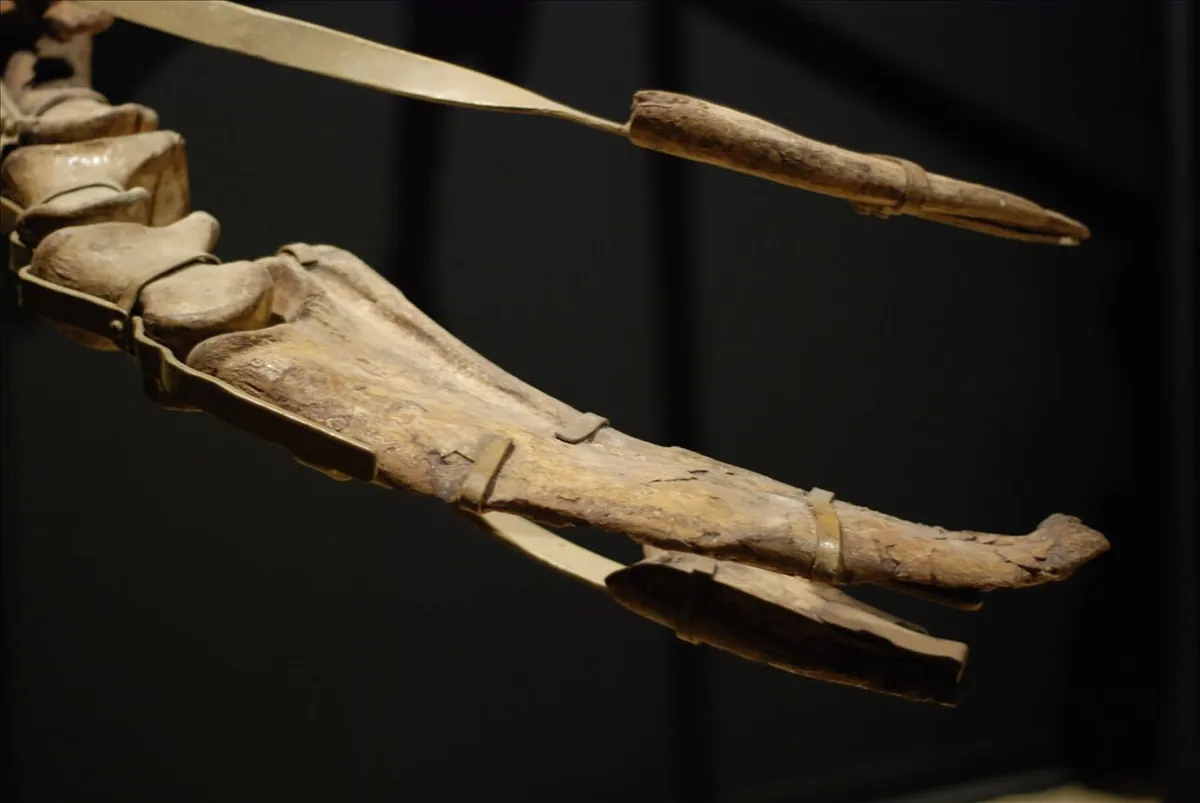
The story of the animal ARK calls the Therizinosaurus starts with a handful of bones nobody could place. In 1948, Mongolian expeditions organised by the USSR Academy of Sciences searched the Nemegt Formation in the Gobi Desert of south-western Mongolia. At a site catalogued as Quarry V, close to the skeleton of a large theropod, they found three partial claw bones, now catalogued as PIN 551-483. They were enormous and strangely shaped, and there was nothing like them on record.
In 1954 the palaeontologist Evgeny Maleev gave the animal its name, Therizinosaurus cheloniformis. The genus name comes from the Greek therízo, meaning to scythe, reap or cut, and sauros, lizard. The species name refers to a turtle, because Maleev believed he was looking at something turtle-like. He pictured a reptile about 4.5 metres long that raked seaweed toward itself with its great claws. It is one of the most memorable wrong guesses in dinosaur science: the “reaping lizard” was a dinosaur that lived nowhere near an ocean.
How the picture was rebuilt
It took decades, and mostly came from other animals. In 1970 Anatoly Rozhdestvensky argued that the bones belonged to a theropod, and Osmólska and Roniewicz supported that view the same year. New material then kept arriving from Mongolia, including a far more complete, articulated specimen with both arms from Hermiin Tsav in 1973, described by Rinchen Barsbold in 1976. The skull of Therizinosaurus itself has never been found, so researchers fill that gap from relatives.
| Year | Event |
|---|---|
| 1948 | Soviet-Mongolian expeditions find three partial claws at Quarry V, Nemegt Formation |
| 1954 | Maleev names Therizinosaurus cheloniformis and reads it as a turtle-like reptile |
| 1970 | Rozhdestvensky proposes a theropod identity, supported by Osmólska and Roniewicz |
| 1973 | A far more complete specimen with both arms is found at Hermiin Tsav (described 1976) |
| 1979 to 1980 | Segnosaurus is named by Perle (1979) and Erlikosaurus follows (1980): relatives that help link the group |
| 1993 | Alxasaurus is described and shows the two relatives belong to a single group |
| 1999 | Beipiaosaurus from China is described with feather impressions, confirming therizinosaurs as feathered theropods |
The key discovery was Beipiaosaurus, described by Xu Xing and colleagues in 1999: a small, feathered therizinosauroid whose body showed what the group really was. Therizinosaurs were not sauropod-like oddities or turtle-lizards. They were feathered, plant-eating cousins of the predators we usually imagine.
What the real animal was
Numbers vary between studies, but the main picture is consistent. Therizinosaurus lived in the Late Cretaceous of Mongolia, in the Maastrichtian stage roughly 69 to 66 million years ago. The Nemegt Formation has never been radiometrically dated, so a Late Campanian age cannot be ruled out. It was the largest known therizinosaur.
| Feature | Estimate |
|---|---|
| Length | 9 to 10 metres |
| Height | 4 to 5 metres |
| Mass | About 3 tonnes (Paul, 2010), later revised to 5 to 10 tonnes. Zanno and Makovicky estimated 6.6 tonnes in 2013. |
| Forelimb | About 2.4 metres long, with a humerus of about 76 centimetres |
| Claws | About 52 centimetres, described as the longest of any known land animal |
| Hindlimb | About 3 metres |
| Neck | About 2.2 metres |
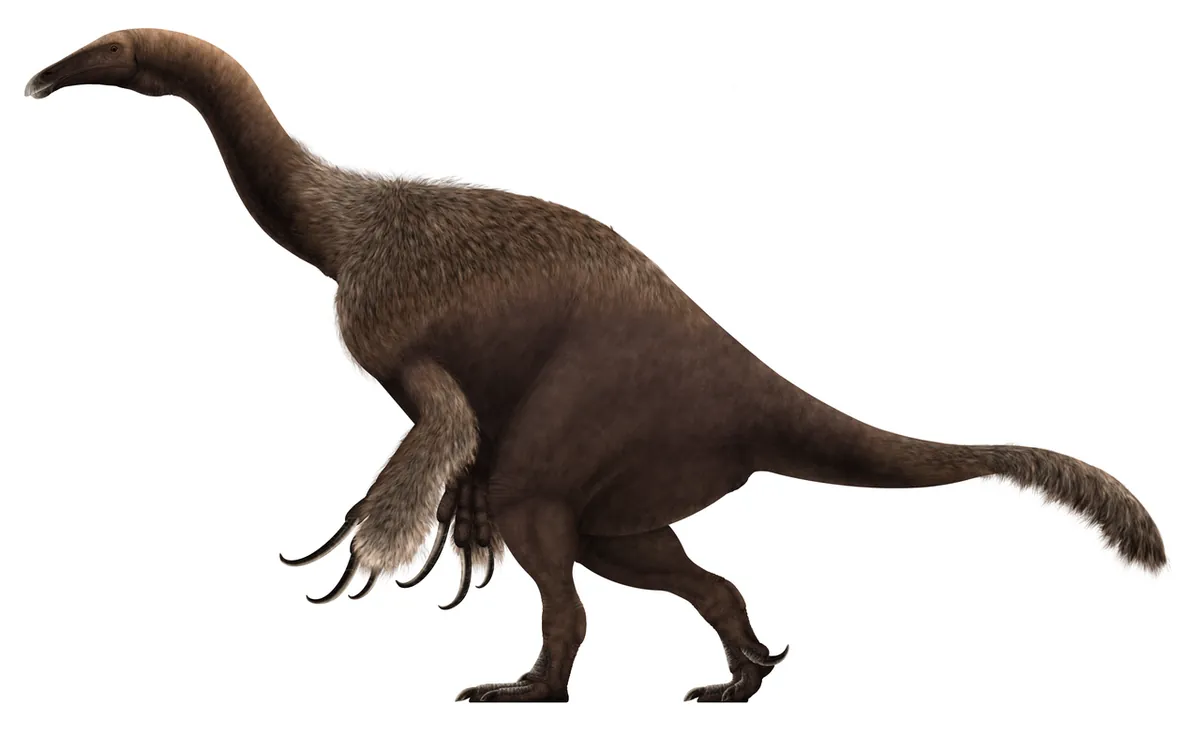
It ate plants. The evidence is a beak, a long neck for high browsing and a large gut for processing leaves. A 1993 comparison likened its build to Chalicotherium, a mammal that evolved a similar body for a similar diet, and proposed that it may have sat down while feeding. A 2018 study suggested a weak bite, suited to cropping vegetation rather than fighting. It walked semi-upright on two legs.
The one thing nobody has is direct proof of its feathers. No feathered Therizinosaurus has been found, and the idea rests on close relatives such as Beipiaosaurus. Every restoration, including the one above, is an informed reconstruction.
What were the claws for?
This is the question the animal is famous for, and the answer is still open. Each proposal tells you something about the science of its decade:
| Who and when | Proposal |
|---|---|
| Maleev, 1954 | Harvesting seaweed (based on the turtle-like reading) |
| Rozhdestvensky, 1970 | Opening termite mounds, or a fruit-based diet |
| Barsbold, 1976 | Impaling or digging, while noting the claws look fragile |
| Nessov, 1995 | Defence and climbing |
| Lautenschlager, 2014 | Hooking and pulling vegetation. Digging judged unlikely. |
| Lee and Richards, 2018 | The arm bones were resistant to stress, suggesting robust use |
| Qin and colleagues, 2023 | No identifiable mechanical function; the claws may be largely a by-product of growth, perhaps display |
Read together, they show a field changing its mind. The most recent study is the most cautious: it could find no job for the claws that explains their size. That is a reminder that spectacular does not have to mean useful.
The Therizinosaurus in ARK
ARK’s version comes from a different direction. Developer Drake first revealed it on 27 June 2015, and it was added to ARK: Survival Evolved in patch 253.0 on 23 December 2016. The community soon nicknamed it “Tickle Chicken”, a nod to the feathered body and the claws. The in-game dossier by Helena Walker lists the species as Therizinosaurus multiensis, from the Late Cretaceous, a herbivore. The only species named in the sources we checked is T. cheloniformis, so the dossier’s name is ARK’s own.
The creature has changed a lot since launch. In ASE, taming times were cut by 60% in patch 253.1, and melee damage was reduced by a third in 253.51. In patch 260.0 a new apex drop, Therizino Claws, was added, and Therizinosaur Claws now appear among the items listed for summoning the Ice Titan in our boss guide. Patch 293.100 made it prefer Exceptional Kibble. In ARK: Survival Ascended, the Therizino TLC arrived on 30 September 2026:
- Look: a thicker, scruffier feather coat, a feathered tail and underside, heavier claws, a longer and sharper avian beak, and a taller, thinner neck.
- Behaviour: before attacking it now enters a warning stance, and becomes passive again if you step far enough away.
- Attacks: its basic attack alternates one claw at a time; before the TLC it always used both.
- Dossier: the old text called it a “solitary predator”, a mistake for a plant-eater. The corrected temperament is territorial, and the dossier says it “will even give interlopers a courtesy warning before attacking”.
What ARK gets right, and what it bends
| Feature | Real Therizinosaurus | ARK |
|---|---|---|
| Diet | Plant-eater with a beak and big gut | Herbivore; the dossier error calling it a predator was fixed |
| Feathers | No direct evidence for this animal; inferred from relatives | Thick, scruffy feathers, more so since the TLC |
| Claws | About 52 cm; function still debated, a 2023 study found none | Combat weapon, alternating swings, and a harvesting tool |
| Posture | Semi-upright, may have sat to feed | Upright mount with a rider saddle |
| Temperament | Unknown | Territorial, with a warning stance before it attacks |
| Species name | T. cheloniformis | Dossier lists T. multiensis |
The most interesting overlap is one we can only describe as our own observation. ARK makes the Therizinosaurus a harvester: it gathers wood, fiber and more, which fits Raconin’s advice that it is especially good for fiber and wood. In science, one of the proposals for the claws, from Lautenschlager in 2014, is that they were used to hook and pull vegetation. The game did not cite that study, but a gathering mount is closer to a respectable hypothesis than to the 1954 seaweed guess.
See it in the game
Raconin’s video shows the four-billboard trap, the kibble tame and why he rates the Therizinosaurus for farming, boss fights and tight-space PvP.
Frequently asked questions
Video credit. The gameplay video at the end is made by Raconin and shown with his permission. The article itself is ParryStack's own research from the sources listed below. Updated 9 November 2026.
Questions or a better method? Ask in the ARK community or share a tip.
Sources & fact-check
Facts on this page were checked against these sources on 9 November 2026. Spotted an error? Tell us. See our editorial standards.
- Wikipedia: Therizinosaurus (discovery, specimens, size, classification, claw hypotheses)
- ARK Wiki: Therizinosaurus (dossier, patch history, TLC details)
- Wikimedia Commons: Therizinosaurus restoration (credit: PaleoNeolitic, CC BY 4.0)
- Wikimedia Commons: Therizinosaurus claws (credit: Frank Black Noir, CC BY 2.0)
- Raconin on YouTube: How to Tame a Therizinosaurus in ARK Survival Ascended