Jedi Power Battles Had a Parry System Before Parrying Was Everywhere
The 2000 Star Wars brawler could turn an incoming shot into a counterattack. Its timing mattered—even if its camera rarely helped.
By Søren Ahrensborg Kamper · Guest feature for ParryStack · November 2, 2026
A battle droid fires. You could rush it, wave your lightsaber and trust that being a Jedi comes with some sort of workplace insurance. Or you could wait until the red bolt is almost on top of you, tap the block button, and send the shot back to its owner. Star Wars Episode I: Jedi Power Battles asked that question in 2000. The surprising thing is that it gave the patient player an answer.
This was not a distant ancestor of Sekiro in disguise, nor the invention of parrying. It was a rowdy arcade beat-’em-up with an unreliable camera, plenty of awkward platform jumps and two-player sessions that could test a friendship more thoroughly than any Sith Lord. Yet hidden inside all that commotion was a small, elegant combat idea: defence could be more than the time you spent waiting to attack.
The difference between surviving a shot and returning it
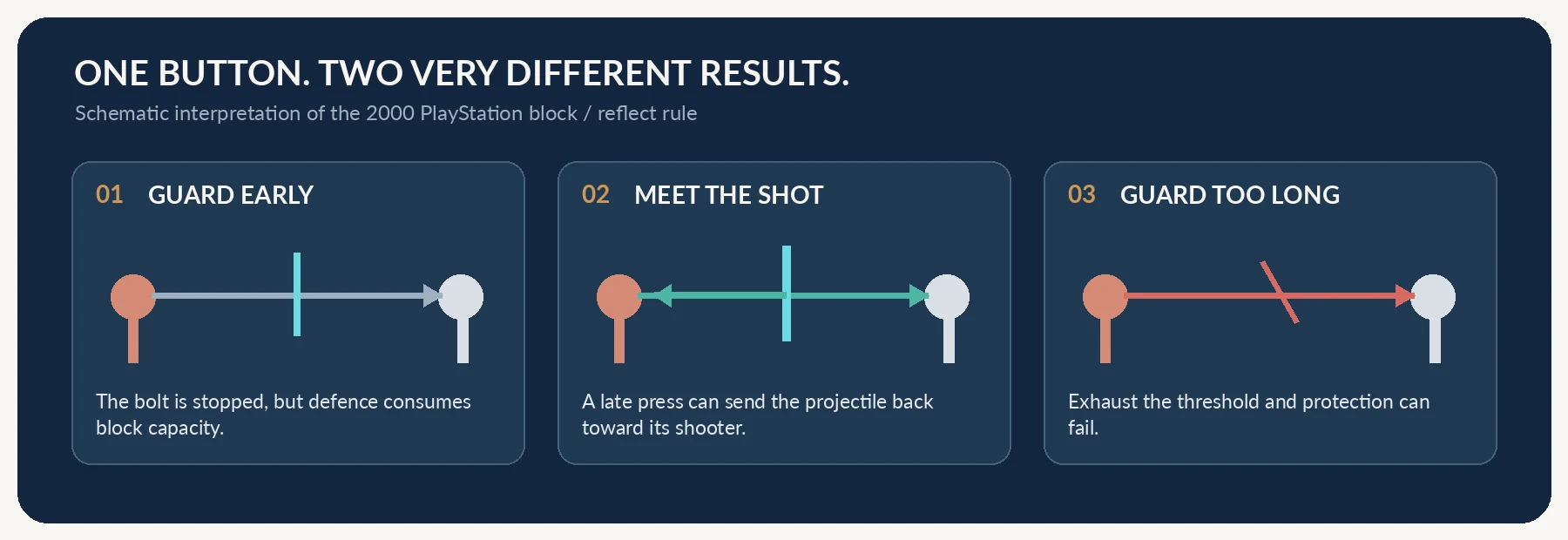
The original PlayStation game gave the block command its own button: L1. The 2000 PlayStation manual also identifies a Block Threshold Meter. Hold your defence too long and the meter runs down; when it reaches its danger state, blocking fails until it recovers. You were allowed to shelter behind the lightsaber, but not to turn the whole level into a permanent waiting room.
An archived PlayStation walkthrough from 2003 describes the more interesting trick. If you press L1 just before a laser reaches you, the projectile can be reflected back at the enemy. A separate player guide revised in January 2001 makes the same distinction between ordinary protection and the deliberate return shot. Neither guide provides a measured frame window, so there is no honest basis for pretending we know its exact duration. What they do establish is the principle: input timing changes the result.
It matters that the incoming attack is a projectile. You do not simply wait for a sword to touch yours; you watch a bright object travel across the screen, judge its speed and make a decision while it is moving. The enemy supplies both the danger and, potentially, the ammunition. The satisfying response is not a faster slash but the recognition that sometimes the best attack is to let the droid fire first.
When the first level insists that you learn
This was no decorative trick tucked into an optional move list. The 2003 walkthrough says the final boss of the opening Trade Federation Battleship level must be beaten by reflecting its shots. For an arcade game usually associated with frantic lightsaber swinging, that is an unusually direct lesson: the boss cannot simply be persuaded to surrender to another three-hit combination. The game wants you to use the enemy’s own rhythm.
The distinction also changes how an encounter with a regular battle droid feels. Closing the distance is a perfectly sensible plan, but reflecting a bolt lets you deal with a shooter without first crossing the space between you. That is a real tactical choice, even if it is hardly a sophisticated one. A corridor full of ranged enemies can briefly become a shooting gallery in which the targets pull their own triggers.
Not all incoming trouble plays along. Contemporary player documentation distinguishes between reflectable blaster fire and other dangers: heavy bursts that eat through your guard, attacks that cannot be sent back, and the familiar problem of falling off the scenery. The game’s defensive system does not save you from poor spatial judgment. If anything, it puts a rather cruel spotlight on the difference between looking impressive with a lightsaber and understanding where your feet are.
Droidekas make an especially useful contrast. Their rapid fire can drain the block threshold when you stand still and hold guard, as the contemporary guides warn. Against those enemies, the supposedly safe option is not free. You have to manage distance, pick a moment to move, or find a more decisive response. Even before anyone started talking about posture meters and perfect guards in every other combat-design conversation, Jedi Power Battles understood one elementary truth: a defensive button becomes more interesting when it has a cost.
The camera, the partner and the very un-Jedi mess
Of course, it is easier to praise the idea than its execution. Jedi Power Battles puts the timing mechanic inside an overhead, partly isometric action game filled with hazards and moving targets. Reading a shot’s approach can be awkward when bodies, scenery and other projectiles overlap. A mechanic that sounds clean on paper has to survive the mess of what the player can actually see. Sometimes it does. Sometimes the camera makes a stronger case for the Dark Side.
Two-player mode adds another layer. The original manual notes that both Jedi share credits and that the camera tracks a position between them; a player stranded too far off-screen can lose a life. One Jedi may be trying to hold a firing lane and turn a droid’s bolt around while the other charges ahead to cut down the shooter. Those are not necessarily incompatible tactics, but coordinating them while also keeping both characters on screen is a small act of domestic diplomacy.
Character differences complicate the rhythm too. LucasArts’ contemporary character descriptions reported by GameSpot in 2000 distinguish the quick Adi Gallia from the slower, stronger Plo Koon, with Qui-Gon leaning more toward Force power and defence. Those differences do not prove separate reflection timings. They do mean that approaching a shooter, retreating to recover and deciding when to stand your ground need not feel identical across the roster.
This is where the game begins to look less like an early version of a modern precision fighter and more like what it actually is: a spirited, uneven experiment. It knows the fantasy it wants to offer. Its camera, collision and platforming do not always cooperate. For a broader look at that unruly release, an external retrospective published on Star Wars: Gaming documents the 2000 PlayStation game, the Dreamcast version and their place in the wider LucasArts catalogue.
What later games made of the same idea
The resemblance to later parry systems is real, but it needs careful handling. Sekiro: Shadows Die Twice turns a correctly timed deflection into pressure on the enemy’s Posture, building toward a Deathblow. That is not simply the reversal of an isolated attack; it is the main grammar of combat, something the player must keep speaking. The official mechanics guide explains the link between deflection, Posture and counterattack, while ParryStack’s Sekiro overview places the system at the centre of the game.
Lies of P takes a related but different route. Its Perfect Guard rewards impact timing with a defensive outcome that builds pressure toward staggering the opponent. As ParryStack’s Lies of P guide explains, this is part of a larger economy of recovery, weapon arts and openings. The thrill comes from gradually turning an opponent’s aggression into a liability. A bright bolt bouncing back at a battle droid belongs to the same broad design family, but it is not equivalent to a system calibrated around repeated guard decisions.
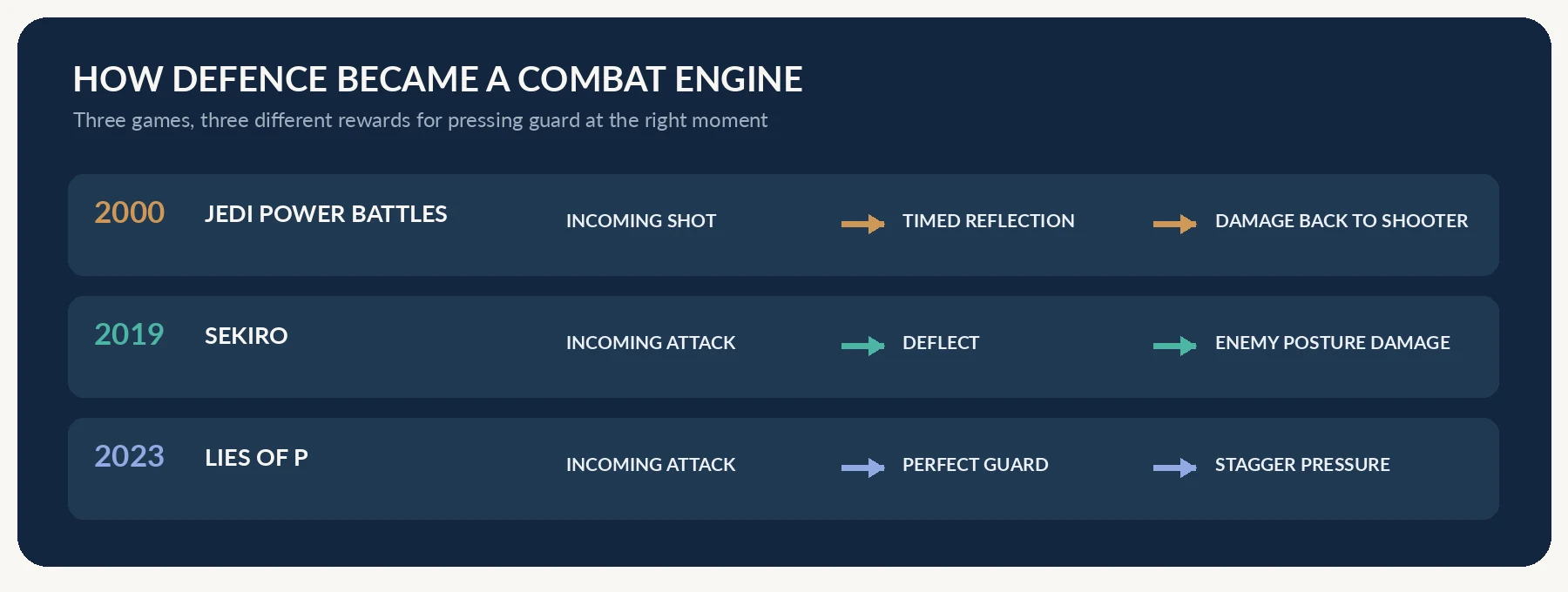
Star Wars itself eventually returned to the idea with rather more deliberate combat language. In Jedi: Fallen Order, guard and parry share a control, but sustained blocking is governed by stamina; Respawn’s lead combat designer said in a 2019 Prima Games interview that the team added conventional blocking after discovering that a parry-only version was too tense. The choice gave players a safety net and helped deliver the essential Jedi experience of reflecting blaster fire. The official EA manual describes the guard control and stamina cost; ParryStack’s Jedi: Survivor guide follows the series’ later emphasis on well-timed defence.
Notice the difference in design priorities. Fallen Order builds a measured combat system around readable individual confrontations. Jedi Power Battles throws the player into a noisy room, hands over an old-fashioned life counter and asks for a little grace under fire. One is concerned with sustained combat mastery; the other occasionally stumbles into an elegant exchange between a shooter and a lightsaber. The common ingredient is not a documented line of influence. It is a simple proposition: a well-timed refusal to be hit can be an offensive act.
A good idea inside a gloriously awkward game
Aspyr’s 2025 re-release, built from the Dreamcast source code with gameplay improvements, made it possible to look again at Jedi Power Battles without treating a surviving PlayStation disc as a museum exhibit. The official Lucasfilm announcement highlights smoother jumping, rebalanced play and returning co-op, a reminder that preservation and modernisation inevitably change how old mechanics are encountered. It does not turn the 2000 design into a contemporary parry simulator.
It would be tempting to claim that a forgotten Star Wars tie-in predicted the next quarter-century of action games. That would make a pleasing headline and a bad history. Timing-based defence existed before 2000, and Sekiro and Lies of P solve problems Jedi Power Battles barely knew how to articulate. What this scruffy little brawler did was more modest, and more worth remembering: it gave a player who was willing to stop swinging for a second the chance to turn an enemy’s shot into a comeback. For one brief moment, the clumsiest Jedi in the room could look like the most attentive.
Sources and image provenance
- Original PlayStation manual (LucasArts, 2000) — default L1 block control, Block Threshold Meter, co-op camera rules. A reproduced manual, not a new gameplay test.
- ChefGhost, PlayStation FAQ (2003) — archival player documentation: timing to return blaster shots, the level-one boss, guard exhaustion and ranged enemies.
- BBorst, Dreamcast FAQ (revised January 2001) — archival player documentation: ordinary blocking versus reflected shots and differences between attack types.
- LucasArts character descriptions via GameSpot (2000) — contemporary press comments on the characters and game concept.
- Sekiro: Shadows Die Twice Game Mechanics (Activision Support, official) — deflecting by pressing guard just before a blow lands, Posture, Counter-slash and Deathblow.
- EA official Fallen Order Xbox One text manual (EA Accessibility) — Block/Parry/Illuminate control and block stamina.
- StarWars.com announcement (Lucasfilm Games / Aspyr, January 2025) — modern edition uses the original Dreamcast source code with gameplay enhancements, smoother jumps and better balance.
- Prima Games interview with Jason de Heras (2019) — adding a conventional block to an initially parry-only system.
- Added by ParryStack editors as independent corroboration of the timed deflection and the L1 block: Giant Bomb, Hardcore Gaming 101 and PSX Data Center (control mapping). Re-release: Games Asylum coverage (released January 2025).
- ParryStack pages: Sekiro, Lies of P guide, Jedi: Survivor guide.
Sources shown without a link are print or archived documents (the PlayStation manual, two archived player FAQs and a 2000 GameSpot report). They are cited as supplied by the author; the editors have not yet confirmed a stable public URL for them.
Editorial transparency: this feature is research-based historical analysis, not an account of a new playtest by the author or by ParryStack. Both figures are explanatory diagrams made with ChatGPT for this article; neither depicts actual gameplay. No third-party screenshots are included.
Data source: published manuals, archived player guides, developer and publisher documentation and press coverage listed above; no ParryStack price or patch data is used. Found an error? Email contact@parrystack.com · Editorial standards