The real mantis: a prophet with a trap for arms
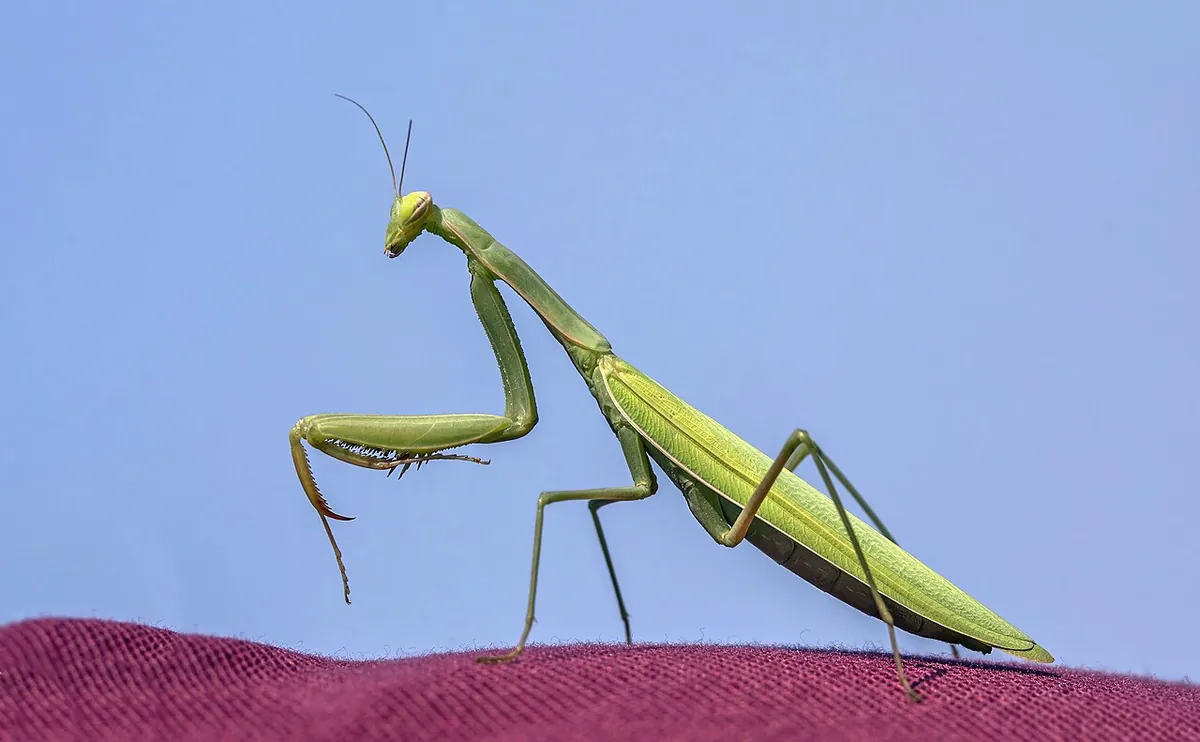
ARK’s Mantis is a rideable, tool-wielding insect, but the animal it borrows from is one of the most distinctive hunters on the planet. Mantises form the insect order Mantodea, named by Hermann Burmeister in 1838 from the Greek mántis, “prophet”, and eîdos, “form”. The “praying” comes from the upright posture with the forelimbs folded in front of the body. Over 2,400 species are known, spread across roughly 430 to 460 genera and 29 to 33 families depending on which part of the same reference you read, and they live worldwide, mostly in the tropics.
Everything about them is built around one weapon. The raptorial foreleg has a first segment (the coxa and trochanter together) about as long as the thigh. The femur usually carries four discoidal spines, though species range from none to five, plus tooth-like tubercles and a claw at the tip. Most mantises are ambush predators that hold still, camouflaged, and let prey walk into range. A few ground-dwelling genera, such as Entella, Ligaria and Ligariella, do the opposite and run prey down.
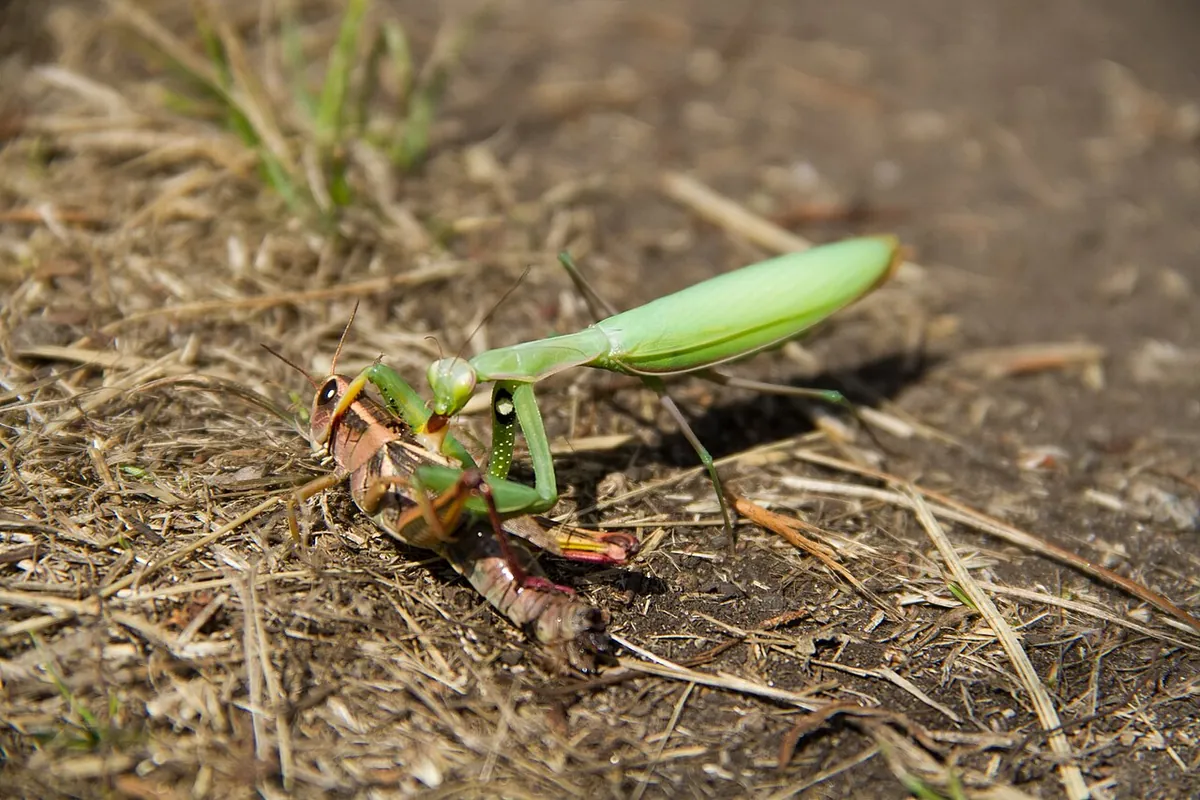
They eat other arthropods, and larger mantises also take small vertebrates, including lizards, frogs, fish and, in some records, small birds. They are generalists, which is why the common idea of the mantis as a precision pest controller is oversold: the same reference describes their value in biological control as negligible.
Eyes that judge depth, an ear that hears bats
What makes the mantis feel intelligent is how it watches. It has stereo vision, a rarity among insects. Its compound eyes contain up to 10,000 facets, with a high-acuity zone at the centre and peripheral facets that detect motion. When something moves at the edge of view, the head turns to bring it into the sharp zone, and some species can rotate their head nearly 180 degrees. A 2016 paper in Scientific Reports by Nityananda and colleagues is the standard citation for stereopsis in insects.
Mantises can also hear, which is unusual for the group of insects they belong to. They are the only members of their wider group with eardrum-type hearing, and most can sense only ultrasound. Two eardrums sit in a single chamber in the thorax. The practical payoff is documented in flight: when a mantis detects a bat’s rising echolocation pitch at night, it stops flying level and drops into a descending spiral, often after a loop or spin.
For the ARK player, that vision and motion detection explain why Raconin’s tame works the way it does: he crouches, approaches from behind and keeps still. That is our reading, not the game’s claim, but a real mantis really does notice movement at the edge of its view first.
Eggs, moulting and the cannibalism question
Mantis life is short and dramatic. In temperate regions mating happens in autumn. The female lays between 10 and 400 eggs in an ootheca, a froth that hardens into a protective capsule. Parasitoid wasps often attack the eggs, and in a few species, such as Tarachodes maurus, the mother guards them. Eggs hatch in three to four weeks in small species and four to six weeks in larger ones. The nymphs moult five to ten times before they are adult. Smaller species live four to eight weeks, larger ones four to six months. A few species reproduce without males: Brunner’s stick mantis has no known males at all.
Then there is sexual cannibalism, the thing most people know about mantises. The numbers are more careful than the myth. In natural populations about a quarter of male-female encounters end with the male being eaten, and around 90 percent of predatory species show the behaviour, which is common in captivity. In the Chinese mantis, 83 percent of males escape any single encounter, though repeated matings raise the cumulative risk. It is still debated whether head-biting happens as often in the wild or is partly an artefact of laboratory conditions, and hungry females are more likely to eat their mates.
Bluffing, fossils and the people who watched them
For defence, mantises have little chemical protection. Instead they bluff. A threatened mantis spreads its forelegs and wings, may flash bright colours on the hindwings and can hiss through its abdomen. The same reference calls these displays largely bluff, backed up by camouflage, leaf and flower mimicry, and in some young, ant mimicry. Flower mantises go further and mimic blossoms to attract prey.
The fossil record starts in the Early Cretaceous, although a Jurassic mantis, Lovec, was reported in 2024 from the Upper Jurassic Karabastau Formation. By 2022 there were 37 fossil species. Cretaceous amber has mostly yielded nymphs, and Santanmantis axelrodi from Brazil’s Crato Formation, described in 2003, is only 10 millimetres long. Nothing in the record looks like a rideable giant.
Humans have always noticed them. Ancient Greeks, Egyptians and Assyrians credited mantises with supernatural powers, and one Greek belief held that a mantis could show a lost traveller the way home. Two Chinese martial arts, Northern and Southern Praying Mantis, base their movements on the insect. In art and fiction they appear as a giant mantis on a sleeping bishop in Escher’s woodcut Dream, in Aldous Huxley’s Island (1962), and as the monster in the 1957 film The Deadly Mantis.
Empusa: the name on ARK’s dossier
ARK’s dossier, written in the voice of Helena Walker, lists the Mantis species as Empusa discipulus. The genus is real. Empusa is a genus of praying mantids in the family Empusidae, named by Karl Wilhelm Illiger in 1798. It has 13 species, including E. pennata, and its records run from Africa and mainland Europe across western Asia to India. The species name discipulus is ARK’s own.
The name itself is older than science. In Greek mythology the Empusa is a shape-shifting female being with a single leg of copper. In Aristophanes’s comedy The Frogs, a character claims to see her turn into a bull, a mule, a beautiful woman and a dog. One ancient commentator says the goddess Hecate sent her, and in late antiquity the empousai became a class of phantoms said to seduce and feed on young men. It is a fitting name for an insect people feared.
ARK then adds its own fiction. The dossier says that “Not only is Empusa the only recorded insect to have developed an opposable digit” before going on to describe its intelligence, and it ends with the line “Caution is recommended.” The ARK Wiki notes that Mantises are among the most intelligent creatures in the game, rivalled only by Troodon and the King Titan, with four intelligence ticks in the dossier, the same as Troodon. A real mantis foreleg works as a spined grasping limb, with spines, tubercles and a claw, not as an opposable thumb.
The Mantis in ARK
The Mantis arrived in ARK: Survival Evolved with the Scorched Earth expansion on 1 September 2016, in patch 246.0. It could not breed at first and laid unfertilised eggs; breeding was enabled in patch 316.18. A Mantis Ghost appears during Fear Evolved events and gives a costume that makes a tamed Mantis look like a ghost. In ARK: Survival Ascended, patch 61.37 added Mantis spawns to Astraeos.
The wiki describes a highly aggressive predator that attacks anything medium-sized or smaller that enters its range, spawning in packs of two or three in caves and on desert dunes. It is taken as a passive tame with Deathworm Horn, with Woolly Rhino Horn also accepted at lower affinity, and you must be level 40 to feed one. It can carry only one tool at a time, and it is rated as the only creature able to speed up Element collection after an Element Node event with a Metal Pick. That is exactly the niche Raconin’s video highlights.
What ARK gets right, and what it invents
| Feature | Real mantis | ARK |
|---|---|---|
| Hunting style | Ambush predator with spined raptorial forelegs | Aggressive predator that attacks anything medium or smaller in range |
| Awareness | Stereo vision, motion detection, head turns up to about 180 degrees | Notices you unless you use Bug Repellent and approach crouched from behind |
| Intelligence | Complex hunting behaviour; the sources we read describe no tool use | Four intelligence ticks, equips a pick, hatchet or sickle |
| Name | Mantis, from the Greek for prophet | Dossier species Empusa discipulus, from a real mantis genus and a Greek myth |
| Reproduction | Eggs in an ootheca, 10 to 400 | Mantis Egg, 2 days 6 hours to mature after hatching |
| Taming | Not applicable | Passive tame with horns, from level 40 |
See it in the game
Raconin’s video shows the ghillie-armor, Bug Repellent and horn-feeding loop, and why he rates the Mantis for farming Element.
Frequently asked questions
Video credit. The gameplay video at the end is made by Raconin and shown with his permission. The article itself is ParryStack's own research from the sources listed below. Updated 9 November 2026.
Questions or a better method? Ask in the ARK community or share a tip.
Sources & fact-check
Facts on this page were checked against these sources on 9 November 2026. Spotted an error? Tell us. See our editorial standards.
- Wikipedia: Mantis (classification, anatomy, senses, life cycle, fossils)
- Wikipedia: Empusa (mantis genus)
- Wikipedia: Empusa (Greek mythology)
- ARK Wiki: Mantis (dossier, trivia, patch history, taming)
- Wikimedia Commons: European praying mantis (credit: Charles J. Sharp, CC BY-SA 4.0)
- Wikimedia Commons: Praying mantis eating a grasshopper (credit: NormsDiner, CC BY-SA 4.0)
- Raconin on YouTube: How to Tame a Mantis WITHOUT a Trap!