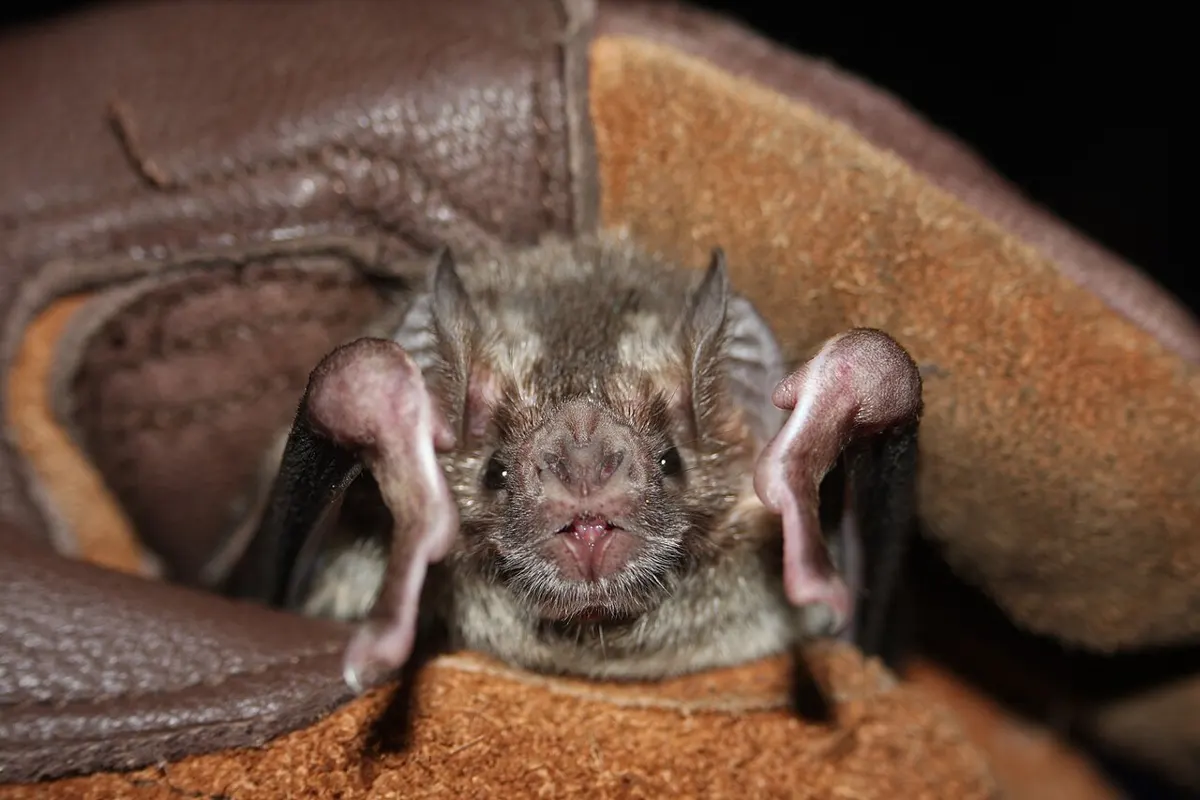
The living vampire bat
The creature ARK calls Desmodus has a real counterpart that is much smaller and, in some ways, stranger. The common vampire bat, Desmodus rotundus, was first described by Étienne Geoffroy Saint-Hilaire in 1810 under another name. Maximilian Wied created the genus Desmodus in 1826 and Oldfield Thomas settled on the current name in 1901. It lives from Mexico through Central and South America and on Trinidad and Margarita, is about nine centimetres long with an 18-centimetre wingspan, and weighs 25 to 40 grams. Two other vampire bat species exist, the hairy-legged and the white-winged.
It is a specialist. It hunts at night, feeding mainly on the blood of mammals, especially livestock such as horses and cattle, and travels five to eight kilometres from its roost to do it. Heat sensors in its nose help it find blood vessels close to the skin. Its upper incisors lack enamel, which keeps them razor-sharp, and it uses them to remove a small flap of skin and then laps up blood with a grooved tongue. Its saliva carries an anticoagulant called draculin, and a drug called desmoteplase, genetically engineered from that protein, has been studied for stroke.
The most surprising behaviour is social. In a field study in Costa Rica between 1978 and 1983, Wilkinson found that bats share blood by regurgitation with roost-mates that failed to feed. About 95 percent of observed sharing was between close kin, and mothers feeding pups made up around 70 percent of it. But among familiar bats that were not closely related, who gave blood to whom was best predicted by who had given before. That finding made vampire bats a classic example in discussions of cooperation. Vampire bats also matter to farmers because rabies in large South American populations is mainly a danger to livestock: the bacteriologist Joseph Lennox Pawan found the first infected vampire bat in Trinidad in March 1932 and showed that bats could carry the virus without symptoms.
The giant bat that really existed
ARK’s dossier uses a name that sounds invented and is not. Desmodus draculae is a real extinct species. Omar Linares collected the first fossil in 1965 in the Cueva del Guácharo in Venezuela and noted it in 1968 as a possible Pleistocene Desmodus. Morgan, Linares and Ray formally described it in 1988, and the species name commemorates Count Dracula. It was about 30 percent larger than the living bat; estimates from the skull put its wingspan near 50 centimetres and its mass near 60 grams, with a skull about 31 millimetres long, long and narrow with an upturned snout. These figures are estimates scaled from skull measurements, not weighed animals.
Fossils have been found in caves in Mexico, Belize, Venezuela, Brazil and Argentina, mostly late Pleistocene and some Holocene. One tentatively assigned canine from Buenos Aires Province dates to roughly 300 years ago and lies about 600 kilometres farther south than any other record. What it ate is debated. One hypothesis says large prey such as megafauna, another points to caviomorph rodents, and others suggest animals such as deer or camelids. The IUCN lists the species as extinct, but the date and cause are unknown. The popular explanation, that a specialist on very large animals starved when the Ice Age giants vanished, is a hypothesis and not an observation.
Desmodus in ARK: Survival Ascended
The ARK Wiki says Desmodus won the Fjordur creature vote that Wildcard ran in 2021, only the second creature picked by a community vote after Dinopithecus. It entered ARK: Survival Evolved in patch 346.11 on 12 June 2022. In Ascended the wiki lists it for Lost Colony in patch 77.5 and for Astraeos in patch 83.0. The dossier, in Helena Walker’s voice, gives Desmodus draculae, Pleistocene, sanguivore and aggressive, and describes a medium-sized bat that harvests Blood Packs and makes Sanguine Elixirs. The wiki also records that the original dossier was community-written, in 2016, and that it is one of only two ARK creatures, the other being the cat, whose in-game scientific name matches its real-world counterpart.
In play, the wiki says it can only be tamed non-violently and wants Blood Packs. You let it grab you while you carry a large stack and the packs drain until the taming bar fills. The wiki notes that repeatedly grabbing and dropping a high-health creature that carries many packs, with Moschops as its example, raises taming efficiency. That is exactly the trick in Raconin’s video, which builds a trap and uses a Moschops to push effectiveness to 100 percent. The wiki’s list of abilities includes a 40-damage bite, a screech that applies a debuff revealing enemies for 20 seconds, a camouflage, wall-latching, 3D flight in which riders can use weapons, and a passive that produces Blood Packs from damage dealt. A saddle lets it craft Sanguine Elixirs from 200 Blood Packs, each giving 30 percent taming or imprinting progress once per creature, which is the elixir the Karkinos guide mentions. The wiki lists its grab as lifting smaller air-only targets, so how it grabs a standing survivor in the video is something to confirm in-game, and we flag it because the wiki and the video do not describe the same thing.
What ARK gets right, and what it bends
Right: a night hunter that lives on blood, echolocation (the screech debuff), clinging to surfaces, and a scientific name that matches a real fossil animal. The fact that a bat can be tamed only by feeding is also in the spirit of the real animal’s dependence on regurgitated meals. Bent: the real giant bat weighed around 60 grams and spanned about 50 centimetres, so a rideable mount that carries a survivor, grabs creatures and flies in 3D is pure fiction. Camouflage, a bite that makes Blood Packs and Sanguine Elixirs are inventions too. As with Helicoprion, the game keeps the animal’s headline trait, here its diet, and scales it up until it becomes a game system. The Desmodus taming guide explains the full routine.
See it in the game
Raconin’s video shows the 63-pillar trap and the Moschops method for a 100% effectiveness Desmodus tame.
Frequently asked questions
Video credit. The gameplay video at the end is made by Raconin and shown with his permission. The article itself is ParryStack's own research from the sources listed below. Updated 1 November 2026.
Questions or a better method? Ask in the ARK community or share a tip.
Sources & fact-check
Facts on this page were checked against these sources on 1 November 2026. Spotted an error? Tell us. See our editorial standards.