A saw with no obvious mouth
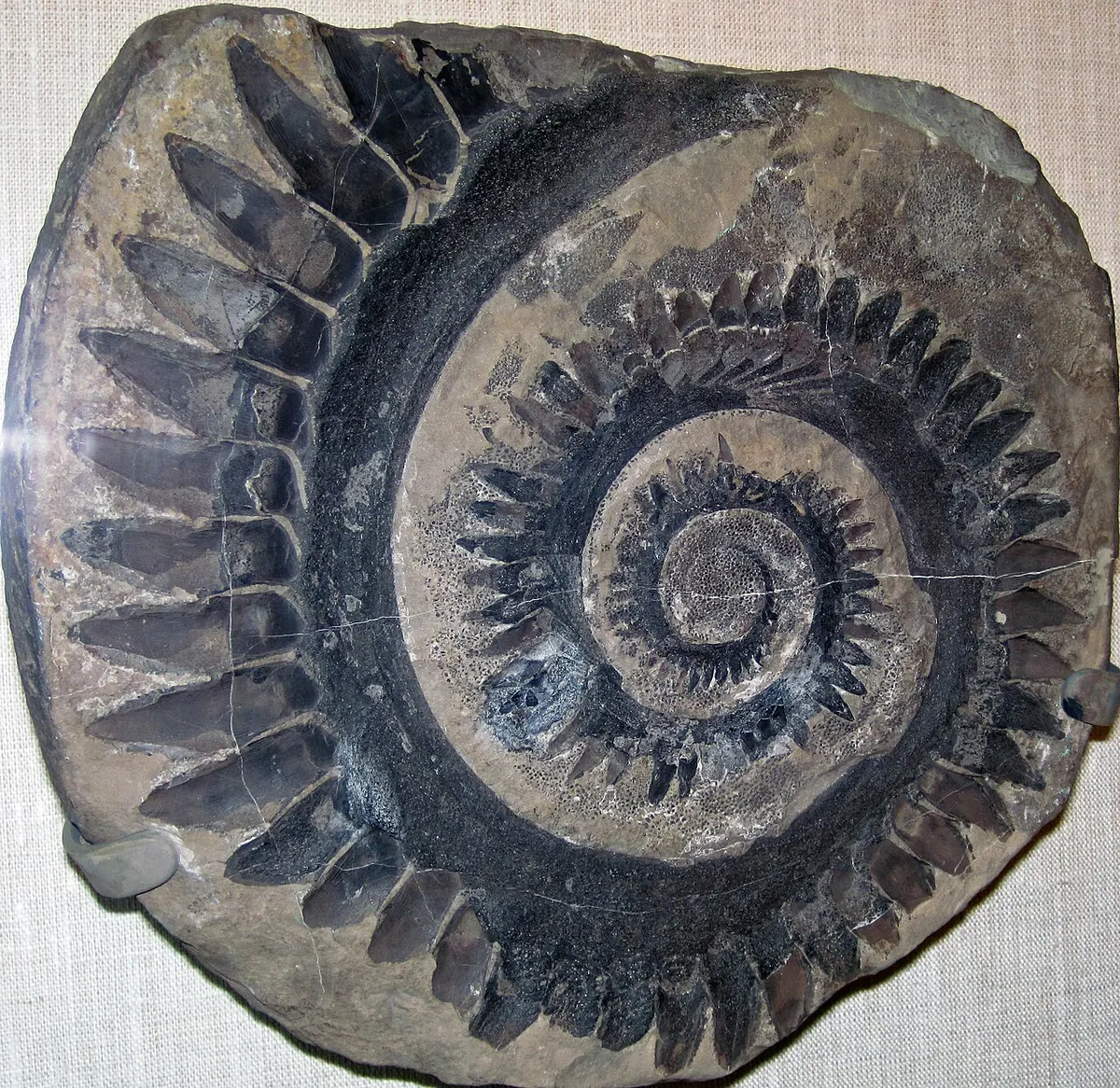
Helicoprion is the fossil that paleontologists argued about for more than a century. In 1899 the Russian geologist Alexander Karpinsky named it, Helicoprion, “spiral saw”, using whorls from a quarry near Krasnoufimsk in the Urals. The type species, H. bessonowi, takes its name from Alexander Bessonov, who found the more complete specimens. A fragment had in fact turned up earlier: a gold prospector named Davis picked up a piece in Western Australia that Arthur Smith Woodward described in 1886, under a different genus name, Edestus davisii. Nobody knew where the coil belonged, because the animal’s soft tissue had rotted away and cartilage rarely fossilises.
The guesses are a small history of palaeontology in themselves. Edward Drinker Cope proposed pectoral fin spines. John Strong Newberry suggested defensive spines of a stingray-like fish. Karpinsky himself changed his mind several times: a coil curling forward from the upper jaw, a plated tail like a seahorse’s, parts of the dorsal fin. Woodward later imagined a dental battery in a large shark’s mouth. In 1966 Bendix-Almgreen put the whorl between the lower jaw halves, in 1994 Matsen and Troll gave the animal a goblin-shark-style snout, and in 2008 Mary Parrish argued it sat deep in the throat. Each idea fitted the single feature everybody could see and struggled with everything else.
The CT scan that settled the position
The answer came from a specimen nicknamed “Idaho 4” (catalogued as IMNH 37899 at the Idaho Museum of Natural History). It is a H. davisii whorl, found in 1950 in a mine near Montpelier, Idaho, in the Phosphoria Formation. In 2013 Leif Tapanila and colleagues published CT images of it in Biology Letters (volume 9, article 20130057). The scans showed a nearly complete set of articulated upper and lower jaws, preserved as calcified cartilage, with the whorl filling the lower jaw and supported along its midline. The press summary from the Royal Society described the whorl as sitting toward the back of the mouth, next to the jaw joint, with a rolling, slicing bite.
The same scans corrected the family tree. The upper jaw connected to the braincase at two points and the hyomandibula, a bone that props the jaw in sharks, was not part of the jaw suspension. Those features place Helicoprion among the stem holocephalans, the group that today survives only as chimaeras, or ratfish. It was never a shark in the strict sense. Tapanila himself stressed that the shark-like teeth are the main thing it shares with sharks.
What science still estimates
Helicoprion lived in the Early to Middle Permian, roughly 290 to 270 million years ago, in seas across the world; the richest fossil beds are in Idaho and Russia. About ten species were named over time, and Tapanila and Pruitt’s 2013 revision recognised three as valid: H. bessonowi, H. davisii and H. ergassaminon.
Size is an extrapolation. With no complete body, researchers scale from smaller relatives. The published range is about 5 to 12 metres. The largest whorl on record, IMNH 49382, is 56 centimetres across and belonged to an animal at least 7 metres long, and Tapanila put the biggest individuals at roughly 9.7 to 12 metres. How it fed is modelled rather than observed. A 2015 biomechanical study by Ramsay and colleagues suggested the front teeth snagged prey, the middle teeth speared it and the rear teeth moved it toward the throat, with a bite force between 1,192 and 2,391 newtons at the contact points. Little tooth wear points to soft-bodied prey, and the whorl may have pulled soft-bodied animals out of hard-shelled nautiloids and ammonoids. The whorl never shed teeth: new ones were added at the apex of the spiral. Its extinction was not tied to a mass-extinction event, and the cause is unknown.
Helicoprion in ARK: Survival Ascended
Helicoprion is one of the few ARK creatures that started with the community. The ARK Wiki lists it as the sixth creature to come from the Additions Ascended mod and records its arrival in patch 71.6, with an August 29, 2025 release date (the wiki notes Steam and Xbox on 71.5 and PlayStation on 71.6 without explaining the difference). It spawns in the open ocean on The Island, The Center, Ragnarok, Valguero, Genesis: Part 1 and Astraeos.
The dossier, written in the voice of the explorer Helena Walker, labels it Helicoprion frendo, Early Permian, docile and a feeder on soft-bodied prey. It says wild specimens are about the size of a Megalodon but much calmer, that they ignore people unless provoked and that ammonites are their main prey. Then comes the invented part: older, domesticated animals use the tooth whorl to pull equipment apart into its components, which reveals how it was crafted. That one line is the lore behind its blueprint ability, and it is a neat piece of design, because it turns the one thing everyone knows about the fossil, an odd cutting tool, into a game function.
As a tame it is passive. You drop looted gear in front of it, ride it, and play a timing minigame; the wiki says the prompts are lenient but a wrong or missed press throws you off and makes it hostile. After ten prompts the final one feeds it Little Ratfish Treats, and you repeat the cycle until the taming bar fills. Once tamed, it converts found, non-crafted quality items into blueprints. The success chance is hard-capped at 90 percent, a failed conversion destroys the item, and its saddle, available at level 91, turns its inventory into a smithy. The wiki warns that its flailing during the minigame can hit nearby creatures for very large damage, so tame it away from your aquatic tames. Raconin’s video shows the whole minigame, and our Helicoprion taming guide and blueprint guide cover the steps.
What ARK gets right, and what it bends
Right: the spiral whorl as its defining feature, the Permian setting, the soft-bodied, cephalopod-leaning diet, and the fact that it is a gentle open-water animal rather than a hunter of survivors. Bent: the species name frendo is not one of the three valid species recognised in 2013, so it is the game’s own label. The Megalodon comparison is also the dossier’s framing; real Helicoprion size remains an estimate between 5 and 12 metres. And nothing in the fossil record suggests it ever sorted equipment. The fun of the creature is that it is honest where the science is honest: ARK, like the 1899 paleontologists, ends up building the whole animal around a spiral of teeth.
See it in the game
Want one of your own? Raconin shows the full taming minigame in his video, and the Helicoprion guide explains each step.
Frequently asked questions
Video credit. The gameplay video at the end is made by Raconin and shown with his permission. The article itself is ParryStack's own research from the sources listed below. Updated 1 November 2026.
Questions or a better method? Ask in the ARK community or share a tip.
Sources & fact-check
Facts on this page were checked against these sources on 1 November 2026. Spotted an error? Tell us. See our editorial standards.